
Reviewed · SAVANNAH TOURS
Heart of Savannah History Walking Tour – 2hr
Savannah’s best introduction may be a walk from one square to the next. This two-hour tour links the city’s founding story with grand houses, battle sites, movie history, and the personalities behind Savannah’s most famous scandals. You begin at Wright Square and finish at the fountain in Forsyth Park, with plenty of benches along the way.
I like the clear route and the mix of major sights with small details, such as the fingerprints pressed into the gray bricks at the Sorrel Weed House. I also like the guides’ lively approach. Rick, Mark, Rose, and Crystal are all praised by name for humor, storytelling, and local insight. The main consideration is pace: some sections can feel long, and one past participant found a guide’s voice hard to hear in a busy area.
Key points to know before you book

- A useful first-day orientation: The walk covers about one mile through Savannah’s historic district and ends near many places you may want to explore later.
- A strong mix of subjects: You’ll hear about the city’s founding, the American Revolution, the Civil War, architecture, Girl Scouts history, film, and local folklore.
- The Forrest Gump stop is brief: Chippewa Square is included, but the tour does not turn into a movie-focused visit.
- Several homes are viewed only from outside: The Juliette Gordon Low Birthplace, Sorrel Weed House, Mercer Williams house, and Armstrong-Kessler house are exterior stops.
- Weather matters: The tour runs in rain or shine, and Savannah’s summer heat and humidity make water and light clothing sensible.
- The route ends at Forsyth Park: You can continue exploring from the fountain, one of Savannah’s easiest places to pause after the walk.
Why this walk works as a Savannah orientation
The tour begins in the center of Wright Square, in front of the Gordon Monument. That opening location gives the guide room to explain Savannah’s unusual city plan before you start moving through it.
Savannah was founded by General James Oglethorpe on a 40-foot bluff. You’ll hear why that high ground mattered, how the colony was organized, and how the squares fit into the original plan. Instead of seeing the squares as separate patches of lawn, you begin to understand them as part of a deliberate urban design.
That context is useful. Savannah can look easy to explore because the historic district is compact, but the repeated squares, lanes, churches, and large homes can blur together during a first visit. A guide gives you a mental map, so later walks have more meaning.
Wright Square also introduces Tomochichi, chief of the Yamacraw Indians. His connection to the early colony adds a human side to the founding story, and the Gordon Monument gives the discussion a clear focal point. The stop lasts about 15 minutes, making it one of the more substantial parts of the tour.
You’ll also hear about the Port of Savannah, described here as the third-largest port in the nation. That detail helps connect the historic city center with the working port that remains important to Savannah today.
More Historical Tours in Savannah
- Savannah History and Haunts Candlelit Ghost Walking Tour
★ 5.0 · 3,235 reviews - Historic Savannah Guided Walking Tour
★ 5.0 · 2,918 reviews - Narrated Historic Savannah Sightseeing Trolley Tour
★ 4.5 · 2,375 reviews
From Juliette Gordon Low to the city’s grand churches
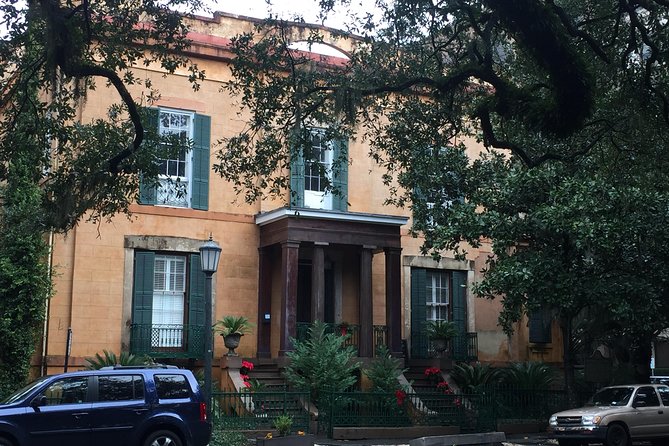
The next stop is the exterior of the Juliette Gordon Low Birthplace Museum. Low was born in the house on October 31, 1860, and later founded the Girl Scouts.
You do not go inside, so set your expectations accordingly. This is a short look at the building and the Gordon family story rather than a museum visit. If the house interests you, you’ll need to return separately for an interior tour.
The tour then moves to Independent Presbyterian Church. Its history is marked by relocation and disaster. It began in 1755 on Ellis Square, originally called Market Square, was destroyed by fire, rebuilt on Telfair Square, and later damaged by a hurricane. The present church was built in 1855 at Bull Street and Oglethorpe Avenue.
The guide points out the steeple and explains why it is so familiar. You’ll also learn which United States president married there in 1885. The stop lasts only about five minutes, but it is a good example of how Savannah’s buildings carry several layers of history at once.
Chippewa Square and Savannah’s movie fame
Chippewa Square is the tour’s most recognizable film stop. This is where Forrest Gump sat with his box of chocolates while waiting for the bus.
The movie connection is fun, but the square’s main story is older. The monument in the center honors General James Oglethorpe, not Captain Morgan, despite the resemblance that prompts the joke. Your guide explains Oglethorpe’s role in creating the colony and what the monument represents.
This is a good stop for mixed-interest groups. Film fans get a familiar location, while history-minded visitors receive more than a quick photo opportunity. The tour does not present the square as a movie set alone. It uses the movie reference as a doorway into Savannah’s founding story.
The stop lasts around 10 minutes. That is enough time for the explanation and a few pictures, but not enough for an extended film discussion.
Gray bricks, ghost stories, and the Sorrel Weed House
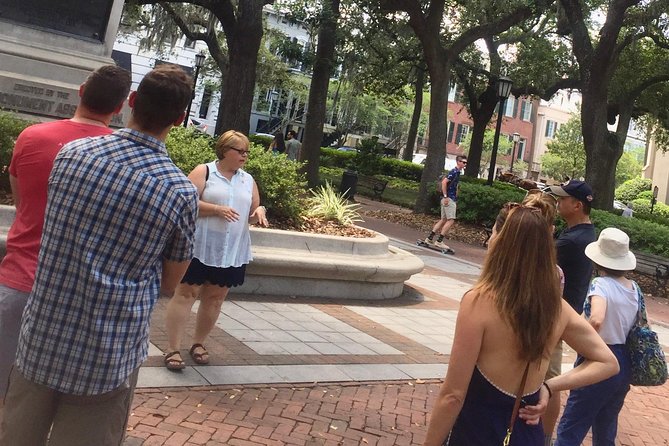
At the Old Sorrel Weed House, you pause outside for about two minutes. The house is known as one of Savannah’s most haunted homes, and the guide explains the gray brick wall around its courtyard.
The curious detail here is the fingerprints in the brick. You’ll hear why they are there and where the brick came from. It is exactly the kind of small physical clue that makes a walking tour worthwhile. You are not just looking at another historic facade. You are learning how construction, labor, local materials, and legend meet in one place.
The stop is brief, and you do not enter the museum. If haunted history is a main reason for visiting Savannah, this tour gives you a taste, not a full ghost walk. One participant thought there were perhaps a few too many ghost stories overall, so your enjoyment may depend on how much folklore you like mixed into the factual history.
More Walking Tours in Savannah
- Savannah First Squares Culinary & Cultural Walking Food Tour
★ 5.0 · 3,229 reviews - Savannah’s Ghost City “Dead of Night” Walking Night Tour
★ 4.5 · 2,482 reviews - Southern Flavors Food, Pub Crawl, and History Walking Tour
★ 4.5 · 1,623 reviews - Genteel and Bard’s Savannah Dark History and Ghost Encounter Walking Tour
★ 5.0 · 1,546 reviews
Madison Square and the Siege of Savannah
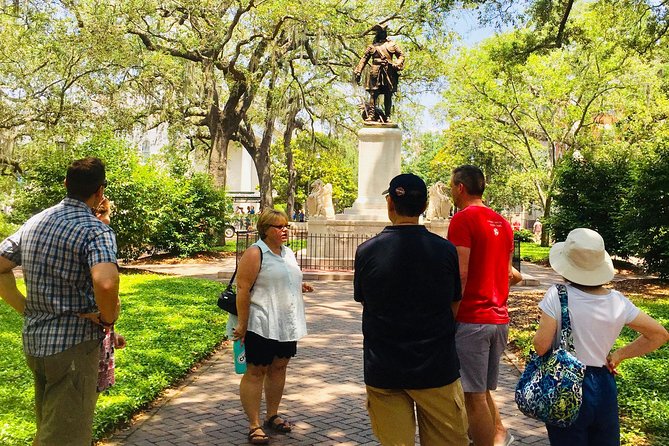
Madison Square takes the story back to the American Revolution. The ground where the square now sits was once the site of one of the conflict’s bloodiest battles, the Siege of Savannah.
This is one of the tour’s strongest examples of contrast. Today, Madison Square is quiet and carefully laid out. The guide helps you picture the violence that once occupied the same space without asking you to leave the historic district for a battlefield site.
The stop lasts about 10 minutes. The value is not in seeing a surviving fortification or battlefield monument. It is in understanding that Savannah’s pleasant squares were also places of war, occupation, and political struggle.
Green-Meldrim House and Sherman’s Savannah
The Green-Meldrim House provides a change of scale. Completed in 1853, it is presented as one of the South’s finest Gothic homes. Its reported cost was $93,000, equal to about $3.2 million today, and it was the most expensive home in Savannah during the 1800s.
The house also played a major role during the Civil War. General Sherman used it as his headquarters during his March to the Sea and after occupying Savannah.
The guide connects architecture with power here. The house is not simply an impressive facade. Its size and cost reveal the wealth of the people who built Savannah’s grand residences, while its use by Sherman places the building inside the military history of the city.
You spend about 10 minutes at this stop. The tour continues past the former Savannah Volunteer Guard building, now owned by the Savannah College of Art and Design. You do not need to plan on entering it, but the passing view adds another piece to the city’s story of changing ownership and use.
Gryphon Tea Room, Mercer Williams, and Savannah’s famous scandals
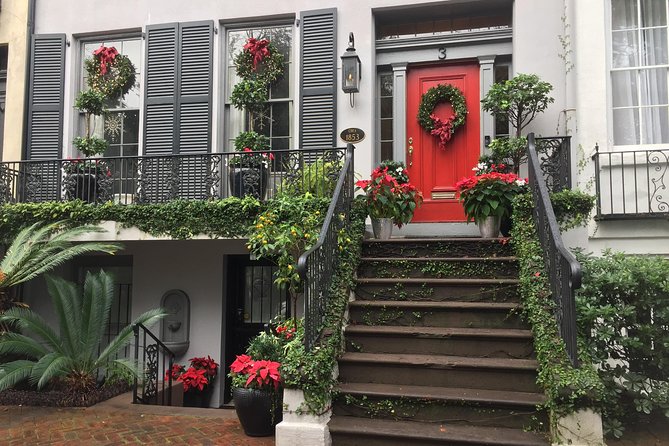
The route passes the building that contains the Gryphon Tea Room. The interior includes original mahogany cabinetry and cubbies from its earlier life as Solomon’s Apothecary. The tea room is also suggested as a place for lunch, dinner, or a rest with tea.
This is a useful recommendation because the tour ends at Forsyth Park, not at a restaurant. You can note the tea room for later instead of trying to fit a meal into the two-hour walk.
The Mercer Williams house is another major story stop. The house became famous through John Berendt’s book Midnight in the Garden of Good and Evil, which tells the story of Jim Williams, the home’s owner, and the 1981 shooting of his assistant, Danny.
The house was purchased by Williams in 1969. The book appeared in 1993 and remained on the New York bestseller list for 216 weeks, followed later by a film that helped bring Savannah to a wider tourism audience.
The guide does not take you inside the house. The value comes from placing the story in its setting and explaining why this particular residence became so closely linked with Savannah’s public image. If you have not read the book or watched the film, doing so before your visit will give this stop more weight. If you prefer architectural history to true crime and local scandal, you may find this section less essential.
The Armstrong-Kessler house and the route’s biggest wow moment
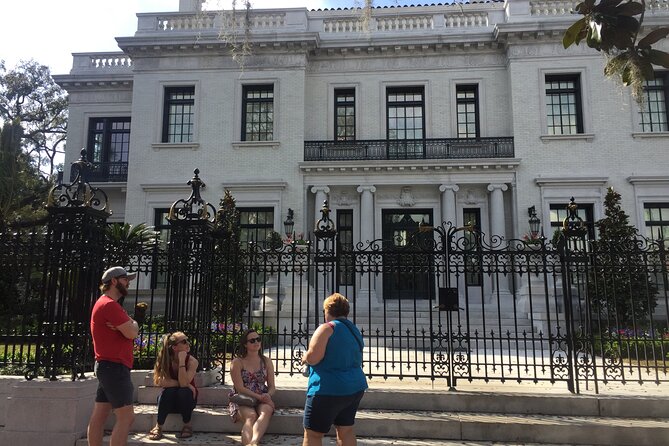
The Armstrong-Kessler house is now a private residence, so you see it from outside. At more than 26,000 square feet, it is the kind of building that demands a pause even before the guide explains who lived there and who occupies it today.
This is described as the house that makes nearly everyone stop and stare. The scale is impressive, but the practical point is simple: do not expect an interior visit or a museum-style tour. You are seeing an extraordinary private home as part of the streetscape.
The stop lasts about 10 minutes. For architecture fans, it may be one of the tour’s highlights. For some people, it may also feel like a long explanation of a building you cannot enter. Your interest in historic homes will shape how much you get from it.
Finishing at the Forsyth Park fountain
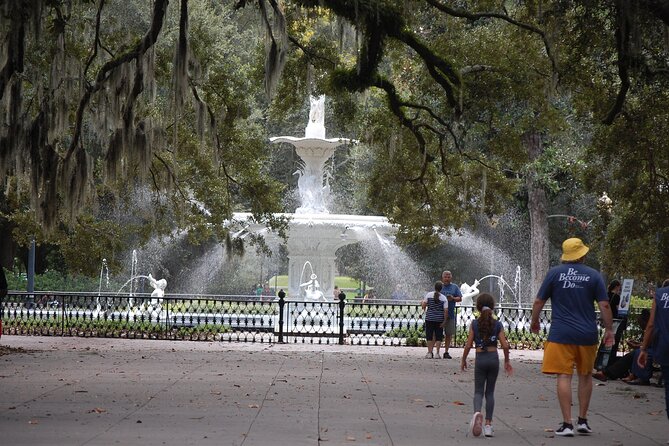
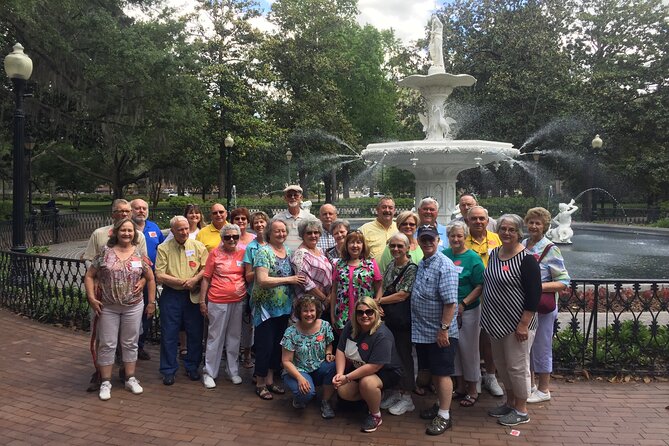
Forsyth Park is where the tour ends. The park began with 10 acres in 1848 and now covers 30 acres. It functions as Savannah’s central public park, with room for both quiet time and everyday city life.
The fountain is the final focal point. It was ordered from a catalog in France and installed in 1858, a detail that makes the ornate structure more surprising. This is the place to take your final picture, then decide where to go next.
Ending here is practical. You are not returned to Wright Square, so remember that when planning your day. From Forsyth Park, you can continue on foot, stop for food, or simply sit beneath the trees after two hours of walking.
Pace, group size, and comfort on the route
The walk covers approximately one mile, but the two-hour duration comes from the many talks at each stop. You are not marching continuously. Benches along the way offer places to sit, which helps, though the tour still requires comfortable walking shoes.
The group can include up to 30 people. That is not a tiny private walk, and a larger group may make it harder to hear in traffic or along busy streets. One past participant specifically suggested microphones for noisy areas, while another noted that a guide’s soft voice made the first part difficult to follow.
Guide style can also affect the pace. Rick, Mark, Rose, and Crystal are praised for being funny, friendly, engaging, and well prepared. Several comments single out the guides’ answers to questions and their ability to add side stories. One lower-rated experience described too much time spent on personal remarks and side notes, while another found the tour a little long and wanted more breaks and question time.
The practical lesson is to stay near the guide and speak up if you cannot hear. If you want a fast sightseeing circuit, this may feel slow. If you want stories and explanations at each square, the pauses are the point.
Heat, rain, timing, and value
Morning and afternoon departures are offered. In summer, Savannah can be hot and humid, so I would favor the cooler time of day when possible and carry water. An umbrella is sensible because the tour operates rain or shine.
The tour requires good weather in severe conditions, with rescheduling or a full refund offered if the operator cancels. Normal rain does not automatically end the walk. The booking terms allow free cancellation up to 24 hours before the start time, but changes or cancellations inside that window are not refunded.
The price is not provided here, so I cannot judge it against a specific dollar amount. The value depends on what you want from your first hours in Savannah. You are paying for a local guide, a planned route, historical interpretation, and an efficient look at many central sights without arranging separate visits.
The walk is especially good value if you are new to Savannah and plan to keep exploring afterward. It is less useful if you have already spent several days studying the squares, or if your main goal is entering museums and historic houses. Admission to the outside stops is free because there is no interior access included.
Who should book this two-hour walk?
I would choose this tour for a first visit, especially on the first morning or afternoon of a Savannah stay. It gives you names, locations, and stories that make later wandering easier.
It suits couples, families, solo visitors, and friends who enjoy history with a little humor and folklore. The route is short enough for most people who can manage about a mile of walking, and most participants can take part. Service animals are allowed, and the route is near public transportation.
I would look elsewhere if you want a small, quiet group guaranteed to hear every word, a dedicated ghost tour, or entry into historic homes. I would also avoid scheduling it immediately before a fixed appointment, since the tour runs about two hours and the guide may spend extra time answering questions.
Should you book it?
Book it if you want a lively introduction to Savannah’s squares, architecture, wars, famous residents, and movie locations in one manageable walk. The strongest reasons are the smart start-to-finish route, the mix of major landmarks and odd details, and guides such as Rick, Mark, Rose, and Crystal who bring humor to the stories.
Skip it if you want extensive interior visits or a tightly timed, fast-moving itinerary. For most first-time visitors, though, this is a sensible way to get your bearings before exploring Savannah on your own.
FAQ
How long is the Heart of Savannah History Walking Tour?
The tour lasts approximately two hours.
Where does the tour begin?
It begins in the center of Wright Square, in front of the Gordon Monument, in Savannah, Georgia.
Where does the tour end?
The tour ends at the fountain in Forsyth Park.
How far do you walk?
The route covers approximately one mile and includes benches along the way.
Is the tour offered in English?
Yes. The experience is offered in English.
Are morning and afternoon tour times available?
Yes. You can choose from a morning or afternoon departure.
Do you enter the historic homes?
No. The Juliette Gordon Low Birthplace, Sorrel Weed House, Mercer Williams house, and Armstrong-Kessler house are viewed from outside. The Armstrong-Kessler house is a private home and is not open for tours.
Is the tour suitable in rainy weather?
The tour operates rain or shine. In severe weather, you may be offered a chance to reschedule. If the operator cancels, a refund is available.
What should you bring?
Wear comfortable walking shoes and consider the weather. In summer, bring a bottle of water because Savannah can be hot and humid. An umbrella is also suggested.
How large can the group be?
The tour can have a maximum of 30 participants.
Can I cancel for a full refund?
Yes, if you cancel at least 24 hours before the experience starts. Cancellations made less than 24 hours before the start time are not refunded.
More Historic Sites in Savannah
- 60-Minute Guided Segway History Tour of Savannah
★ 5.0 · 1,163 reviews - Savannah: Old Savannah Tours Historic Overview
★ 4.6 · 874 reviews - Bonaventure Cemetery Scenic History Art Symbols and Film Tour
★ 5.0 · 870 reviews - Bonaventure Cemetery & Wormsloe State Historic Site Tour
★ 5.0 · 805 reviews
Newly listed in Savannah
- 2-Hour Savannah Sunset Riverboat Cruise★ 4.0 · 487 reviews
- Guided Savannah Civil War History Walking Tour★ 5.0 · 492 reviews
- Spirits and Scoundrels Adults Only Savannah Ghost Tour | 10pm★ 5.0 · 493 reviews
- Savannah: Riverboat Cruise & City Tour Combo★ 4.5 · 528 reviews
- Savannah Supernatural Haunted Walking Tour★ 5.0 · 546 reviews
- Southern Flavors of Savannah Walking Dessert Tour★ 4.5 · 560 reviews
- Savannah Beyond Good & Evil Tour★ 4.5 · 561 reviews
- Savannah: Historic District Foodie Walking Tour★ 4.8 · 613 reviews
Savannah Tours, compared.

90-Minute Savannah Riverboat Sightseeing Cruise
Read our review →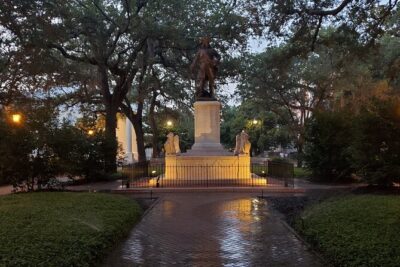
Savannah History and Haunts Candlelit Ghost Walking Tour
Read our review →
Savannah First Squares Culinary & Cultural Walking Food Tour
Read our review →

Savannah’s Ghost City “Dead of Night” Walking Night Tour
Read our review →
Narrated Historic Savannah Sightseeing Trolley Tour
Read our review →Browse the lists this tour appears in