
Reviewed · BOSTON TOURS
Freedom Trail Walking Tour 250
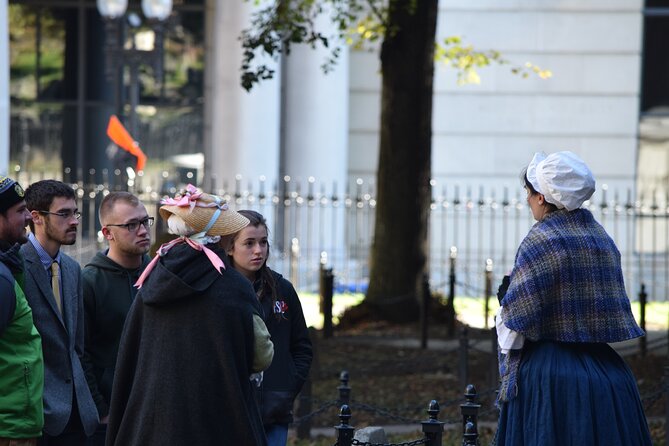
Boston’s Freedom Trail is easy to follow on your own, but a good guide gives the brick path a human voice. This tour uses costumed, in-character guides to connect Granary Burying Ground and the Boston Massacre Site with stories about Sam Adams, Paul Revere, Benjamin Franklin, and everyday colonial life.
I like the compact 1.2-mile route, which covers major sights in about 1 hour 45 minutes, and I like the theatrical approach. Guides such as Ben, Elizabeth, Catherine, and Elaina have been singled out for strong storytelling, friendly energy, and keeping children engaged.
The drawback is uneven delivery. Some guides lean hard on jokes or spend too much time in the cemetery, and a large group can make it hard to hear or move smoothly between landmarks.
Key points at a glance
- Costumed storytelling: Guides remain in character, turning dates and names into personal stories about colonial Boston.
- A short route with major landmarks: You cover about 1.2 miles and see sites tied to the Revolution, early education, religion, publishing, and government.
- Best guides make the difference: Ben, Elizabeth, Catherine, Elaina, and Mrs. Palmer have earned especially warm praise for energy and clear storytelling.
- Granary Burying Ground gets the most time: Plan on about 20 minutes there, which suits history fans but may feel long if you prefer steady walking.
- Old South Meeting House admission is extra: The tour explains the Boston Tea Party site, but entry is not included.
- All-weather operation: Wear suitable clothing and solid walking shoes. Free cancellation is available up to 24 hours before departure.
Why a guide helps on Boston’s brick trail
The Freedom Trail is not hard to locate, and you can walk much of it without paying for a tour. The challenge is knowing what deserves your attention. A red line and a plaque can tell you where something happened, but they do not always explain why the place mattered or how one event led to another.
That is the useful part of this experience. Your guide links the stops into a story about Boston before and during the American Revolution. You hear about the Founding Fathers, religious life, public education, protest, burial customs, and the growing conflict with Britain.
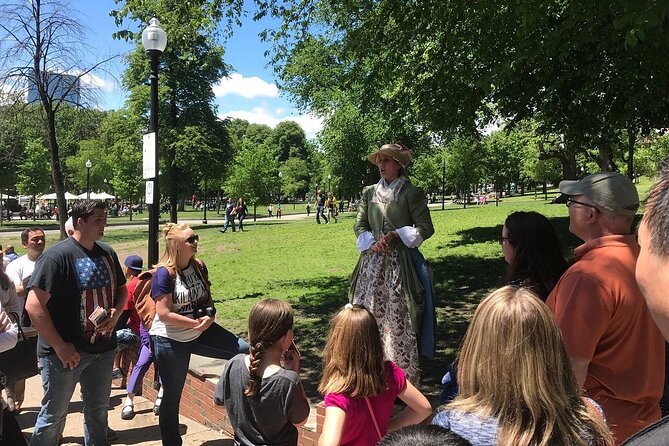
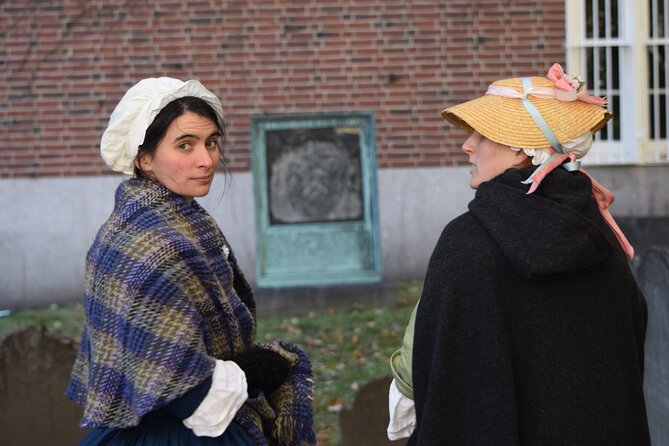
The in-character format gives the tour a bit of theater. One guide might appear as a middle-class colonial woman, while another takes on the persona of a historical figure. This can make the hour and 45 minutes lively, especially for families. It also means the tone is not strictly academic. You should expect humor, personality, and a few dramatic flourishes alongside the facts.
The strongest guides combine both sides well. Ben has been praised for being funny while staying informed. Elizabeth has been noted for making the stories flow from one stop to the next. Elaina has a warm, energetic style that works well with young children, including a four-year-old. Catherine is praised for answering questions and pointing out details people had missed on earlier walks.
Guide quality is the biggest variable here. A skilled storyteller can make a familiar route feel fresh. A weaker one may rely on jokes, use oversimplified history, or leave you wanting more detail.
More Walking Tours in Boston
- Boston: Freedom Trail History Small Group Walking Tour
★ 5.0 · 6,450 reviews - Harvard University Campus Guided Walking Tour
★ 4.5 · 3,632 reviews - Boston Freedom Trail Walking Tour with Costumed Guide
★ 4.5 · 2,531 reviews
From Park Street Church to the city’s oldest graves
The walk begins around the current Massachusetts State House area and moves to Park Street Church. This church is associated with the first performance of My Country ’Tis of Thee, giving the opening stop a link to American musical and civic life.
You get about five minutes here, so expect a quick introduction rather than a full church visit. That short pause is useful at the start because it gets you into the rhythm of the tour without using too much time on one building.
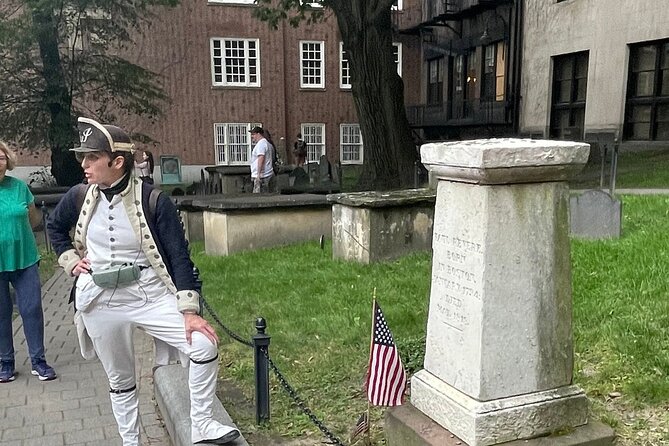
The main early stop is Granary Burying Ground. The tour allows about 20 minutes here, considerably more than at most other points. This cemetery is tied to several important figures from the Revolutionary period, and the guide uses the graves to discuss the people behind Boston’s political story.
I understand why this is the centerpiece. Names such as John Hancock, Samuel Adams, Paul Revere, and other colonial figures become less distant when you hear about their roles and final resting places in the same setting. The cemetery also gives the guide a place to discuss how people remembered the dead and how public memory shaped the new nation.
Still, the long stop will not suit everyone. One common criticism is that too much of the tour is spent standing in the burying ground, with too little movement and not enough time for questions. If you enjoy cemetery history, this is a strength. If you want a brisk walk from one landmark to the next, it may test your patience.
Wear shoes with good support. The route is not described as strenuous, and one guide was praised for setting an easy pace, but this is still a walking tour with repeated stops on city streets and in an old cemetery.
King’s Chapel and Boston’s early religious life

King’s Chapel is introduced as America’s first Anglican church. The tour gives it about five minutes, so you will receive the key historical point and a short explanation of its place in colonial Boston.
This is a good example of how the tour works best as an overview. You are not spending a long time inside each attraction. Instead, you are getting a series of compact explanations that show how religion, politics, and daily life overlapped in the colonial city.
The itinerary also identifies Boston’s oldest English burial ground as part of this section of the route. That detail helps put the city’s age into perspective. Boston is not simply a collection of Revolution-era monuments. Its burial grounds and churches reach back to the earliest English settlement period in the city.
Do not book this walk expecting extended interior visits at every church or historic building. The schedule is built around outdoor stops and brief talks. That keeps the tour within its advertised duration, but you may want a separate visit if you wish to explore a particular site in depth.
Boston Latin School and Benjamin Franklin
At Boston Latin School, you hear about America’s first public school. The stop lasts about five minutes, just enough to explain why education mattered in colonial Boston and how the school fits into the city’s early civic life.
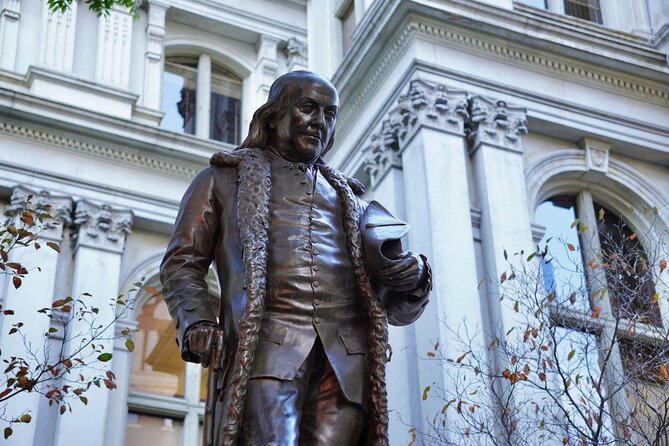
The nearby statue of Benjamin Franklin adds a personal connection. Franklin is presented as both a Founding Father and the school’s most famous alumnus. This is a useful moment because it shifts the focus from monuments and battles to education, ambition, and the people who shaped the new country through writing, politics, science, and public service.
For families, these two stops can help keep the story grounded. Children may connect more readily with the idea of a school and a famous former student than with a long discussion of political disputes. Guides who tell the story with energy have been particularly effective with younger members of the group.
The five-minute timing also keeps this section from becoming too detailed. You will get the main idea, not a full lecture on Franklin’s life or the history of American schooling.
More walking tours around Boston:
- The Full Revolutionary Story Epic Small Group Boston Walking Tour
★ 5.0 · 2,356 reviews - Boston’s Freedom Trail: A Revolutionary Walking Tour
★ 4.9 · 1,748 reviews - Boston: Freedom Trail History Small Group Walking Tour
★ 4.9 · 1,590 reviews - Boston’s Freedom Trail: A Revolutionary Walking Tour
★ 5.0 · 1,343 reviews
Old Corner Bookstore and the power of printed words
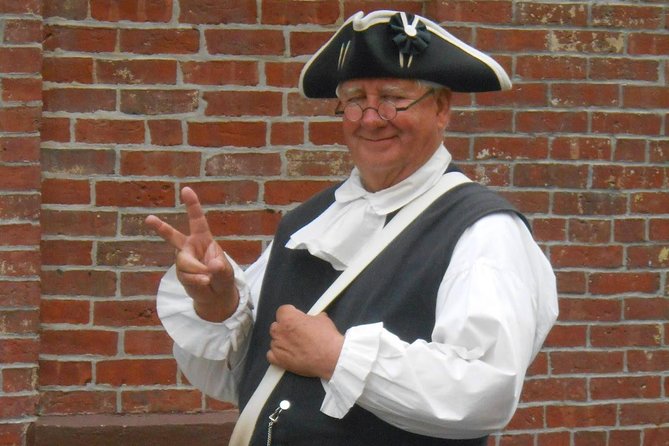
Old Corner Bookstore is identified as America’s oldest commercial building. It is also linked to the publication of The Midnight Ride of Paul Revere, making the stop a natural place to discuss how printed stories shaped public opinion.
This is one of the route’s more interesting changes of pace. The tour is not only about where people fought or died. It also shows how books, newspapers, and popular writing helped create shared patriotic stories.
The stop is scheduled for about five minutes. That is enough for context and a look at the building, but not for an extended discussion of publishing in colonial Boston. I like having this kind of stop in the route because it broadens the experience beyond the standard list of battles and famous speeches.
It also prepares you for the tour’s general approach. The guide is likely to focus on memorable details and connections rather than give a complete academic account of every building.
Old South Meeting House and the Boston Tea Party
Old South Meeting House is where the tour discusses the Boston Tea Party. The building is also described as Boston’s oldest standing government building, adding another layer to its importance.
You get about ten minutes here, which gives the guide more room to explain the protest and the political pressure surrounding it. This is one of the stops where a clear storyteller matters. The event is familiar, but the setting helps you understand that the Boston Tea Party grew out of organized debate and public anger, not a random burst of disorder.
Admission to Old South Meeting House is not included. The walking tour covers the historical setting, but you should plan to pay separately if you want to go inside. That is not a major problem at this price, but it matters when you compare the total cost of your day.
The tour is priced at $26 per person. For that fee, you are paying mainly for interpretation, pacing, and the guide’s ability to connect the sights. You are not buying entry to a package of historic buildings. I consider the price fair if you want a lively introduction and do not already know Boston’s Revolutionary story. It is less compelling if you plan to read the plaques yourself and prefer to spend your time inside the sites.
Boston Massacre Site and the road to revolution

The Boston Massacre Site receives about ten minutes. Here you hear how the killing of civilians became a powerful protest image and a rallying cry during the conflict with Britain.
This is a strong stop for understanding how political messaging works. The event mattered not only because of what happened that night, but also because of how patriot leaders presented it to the public. A good guide will help you separate the event itself from the way it was used to build opposition.
The tour also includes stories about Sam Adams. That may come near this part of the walk or another point along the route. Adams is a useful figure for explaining Boston’s political organizing and the way local leaders pushed resistance forward.
This is another place where tone matters. Humor can make a difficult subject easier for families to follow, but jokes that replace explanation can wear thin. Some guides have been praised for showing both the admirable and flawed sides of historical figures. That approach is worth seeking because the Revolution was driven by real people with mixed motives, not polished statues.
Faneuil Hall and the route’s final landmarks
Faneuil Hall Marketplace is described as Boston’s most iconic historical attraction. The tour gives you about five minutes, enough for a quick explanation of its place in the city’s public and commercial life.
The name Faneuil Hall can cause some confusion because the historic hall and the larger marketplace area are closely associated but are not exactly the same thing. This tour gives you an orientation rather than a detailed visit. If the building interests you, you may want to return on your own with more time.
The route also identifies the Paul Revere House, built in 1680 and described as Boston’s oldest residential building. The supplied schedule does not list an admission or an interior visit, so treat this as a point of historical context rather than a promise that you will tour the house inside.
The full route is about 1.2 miles, though the actual experience can feel longer because of the time spent standing and listening. The tour finishes with you better oriented to Boston’s oldest central streets, but it is not designed to cover every Freedom Trail attraction in detail.
Group size, sound, and the real pace
The stated maximum is 50 people. That is a sizable group for narrow sidewalks, cemeteries, and crowded historic sites. You will want to stay close enough to hear the guide and follow instructions when the group moves.
Several guides have been praised for projecting clearly even when other groups were nearby. That is a real advantage in central Boston, where multiple tours may gather at the same landmarks. Still, sound and visibility depend on where you stand. Try to remain near the guide, especially at Granary Burying Ground and the Boston Massacre Site.
The pace is generally manageable. One detailed account described the walk as roughly one and a half miles with an excellent pace, while the official route is about 1.2 miles. The difference may come from small movements within each stop, but the practical point is the same: this is a moderate city walk, not a long hike.
You should also expect pauses rather than continuous walking. The tour spends substantial time explaining each location. That works well for people who want stories, but it may disappoint you if you imagined a fast stroll along the entire trail.
Who will get the most from this tour
I would choose this experience for a first visit to Boston, especially if you want an organized introduction before exploring the city independently. It gives you a useful framework for later visits to the Old South Meeting House, Paul Revere House, Faneuil Hall, or the other Freedom Trail sites.
Families are a strong match when the guide uses theatrical storytelling. Children may stay focused more easily when history is presented through characters, humor, and short stops. The tour has also worked well for groups that include both teenagers and grandparents, as long as everyone is comfortable standing outdoors.
History fans should check their expectations. You will hear many useful stories, but this is a broad introduction rather than a specialist lecture. The best guides balance facts with personality, while weaker performances can feel superficial or too focused on comedy.
The tour is offered in English only. Most people can participate, and service animals are allowed. It operates in all weather conditions, so dress for the forecast and bring walking shoes. If poor weather causes cancellation, you are offered another date or a full refund.
You can cancel for a full refund up to 24 hours before the start time. Changes or cancellations inside that window are not accepted for a refund, so do not wait until the last day if your plans are uncertain.
Is the $26 price fair?
At $26, this is a reasonable spend for a guided introduction to Boston’s core historic district. You are getting a professional guide, an organized route, and stories that tie several famous sites together without committing to a half-day tour.
The value depends heavily on the guide. Ben, Elizabeth, Catherine, Elaina, Mrs. Palmer, and several other named guides have been praised for humor, warmth, historical detail, and good control of the group. You cannot count on receiving one particular guide, but the range of strong performances shows what the tour can offer.
The price is less attractive if you want admission to historic interiors. Old South Meeting House is specifically not included, and the short stop lengths suggest that several other locations are viewed from outside or treated briefly. Think of the fee as payment for interpretation, not an attraction pass.
Booking about 13 days ahead is the average pattern, so reserving early is sensible if your Boston dates are fixed. You also have a choice of start times, which helps you fit the walk around meals and other sightseeing.
Should you book the Freedom Trail Walking Tour?
Book it if you want a short, story-driven introduction to Boston and you prefer a guide to reading signs on your own. The route covers the key themes, the walking distance is manageable, and a strong in-character guide can make colonial history easy to follow.
I would especially recommend it for families, first-time visitors, and anyone who wants context before visiting the historic interiors. Requesting a particular guide may not be possible, but names such as Ben, Elizabeth, Catherine, and Elaina are worth noting if the operator allows guide requests.
Skip it if you want a quiet, highly academic tour, a small private group, or long interior visits. The group may be large, the cemetery stop may feel overlong, and the humor will not suit every taste.
For most people, the best way to approach this is as a lively orientation to Boston’s revolutionary center. Keep your expectations focused on storytelling and context, wear comfortable shoes, and leave time afterward to explore the buildings that catch your interest.
FAQ
How much does the Freedom Trail Walking Tour cost?
The tour costs $26 per person.
How long is the tour?
The walking tour lasts approximately 1 hour and 45 minutes.
How far do you walk?
The route covers approximately 1.2 miles, or two kilometers.
What language is the tour offered in?
The experience is offered in English.
What landmarks are included?
The route includes Park Street Church, Granary Burying Ground, King’s Chapel, Boston Latin School, the Benjamin Franklin statue, Old Corner Bookstore, Old South Meeting House, the Boston Massacre Site, and Faneuil Hall Marketplace. The route description also identifies the Paul Revere House and Boston’s oldest English burial ground.
Is admission to the historic buildings included?
Most listed stops are described as free admission or short outdoor stops. Admission to Old South Meeting House is not included.
How large is the tour group?
The stated maximum is 50 people.
Does the tour operate in bad weather?
The tour operates in all weather conditions, so you should dress appropriately. If the experience is canceled because of poor weather, you will be offered another date or a full refund.
Can I cancel for a full refund?
Yes. You can cancel at least 24 hours before the start time for a full refund. Cancellations or changes made less than 24 hours before the start time are not accepted for a refund.
Newly listed in Boston
- New England Aquarium Admission Ticket in Boston★ 4.0 · 446 reviews
- Boston’s Politically Incorrect North End Food Tour★ 5.0 · 453 reviews
- Boston’s North End Food and History Walking Tour★ 5.0 · 459 reviews
- Downtown Freedom Trail, Beacon Hill & Back Bay Walking Tour★ 4.5 · 473 reviews
- Cambridge, Massachusetts: MIT and Harvard Walking Tour★ 4.7 · 486 reviews
- Narrated Sunset Cruise of Boston Harbor★ 4.0 · 532 reviews
- Sightseeing Day Sail around Boston Harbor★ 5.0 · 541 reviews
- Boston: Harbor Sunset Yacht Cruise★ 4.6 · 570 reviews
Boston Tours, compared.

Boston Duck Boat Sightseeing City Tour with Cruise Along Charles River
Read our review →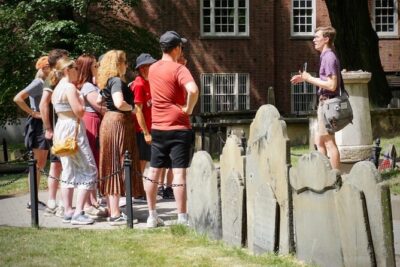
Freedom Trail History Small Group Walking Tour
Read our review →
Boston Hop-On Hop-Off Trolley Tour with 13 Stops
Read our review →

Boston Duck Tour: The Original and World-Famous
Read our review →
Harvard University Campus Guided Walking Tour
Read our review →
Boston Fenway Park: Guided Ballpark Tour with Options
Read our review →
Boston to Martha’s Vineyard Day Trip with Optional Island Tour
Read our review →Browse the lists this tour appears in