
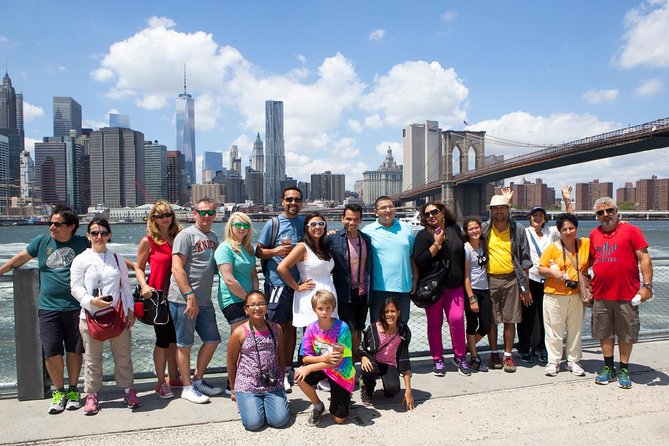
Reviewed · NEW YORK CITY TOURS
Brooklyn Bridge & DUMBO Neighborhood Tour – from Manhattan to Brooklyn
The best part of this tour is the change of scene. You begin among Manhattan courthouses and city offices, cross one of New York’s great landmarks, then finish among DUMBO’s old warehouses, galleries, cafes, and waterfront parkland. I like the bridge engineering stories and the way the tour gives you time for photos instead of treating the crossing as a race.
I also like the useful ending at Brooklyn Bridge Park. Your guide can point you toward lunch in DUMBO and onward directions, which makes this more than a bridge crossing. The main drawback is pace: a group of up to 30 people can mean repeated waits while everyone gathers at set points.
Key things to know before crossing
- The walk begins in Manhattan: Meet at Tweed Courthouse, 52 Chambers Street, near City Hall and public transportation.
- The bridge crossing takes about 50 minutes: The full tour lasts roughly 2 hours and 30 minutes, with stops before and after the bridge.
- You get civic history before the famous views: The Municipal Building and Lower Manhattan help explain New York’s growth.
- DUMBO is part of the experience: Expect cobbled streets, converted warehouses, galleries, cafes, restaurants, and performance spaces.
- The tour ends in Brooklyn Bridge Park: This is a useful place to continue sightseeing or stop for lunch in DUMBO.
- A moderate level of fitness is needed: The walk includes the 1.1-mile bridge crossing and several periods of standing.
Why this Manhattan-to-Brooklyn route works
Many Brooklyn Bridge walks begin on the Brooklyn side or focus only on the bridge itself. This route has a better story arc. You meet in Lower Manhattan, learn about New York’s civic center, cross into Brooklyn, and then see how DUMBO developed into an arts and food district.
That order matters. Manhattan gives you the setting for the bridge. Brooklyn gives you the payoff. By the time you reach DUMBO, you have moved from grand government buildings to working waterfront neighborhoods and converted industrial spaces.
The price is $49 per person. I consider that fair if you want context, guidance, and a planned route rather than simply walking across on your own. The bridge is free, and you can certainly cross it without a guide. What you are paying for is the explanation of how it was built, why it mattered, and how the surrounding neighborhoods changed.
The tour is offered in English, with a maximum group size of 30. That cap keeps the walk manageable, though it is not an intimate private tour. A group of 24 to 25 can feel large at busy points on the bridge, especially when everyone gathers around the guide.
More to weigh up across New York City
- NYC: SUMMIT One Vanderbilt Tickets
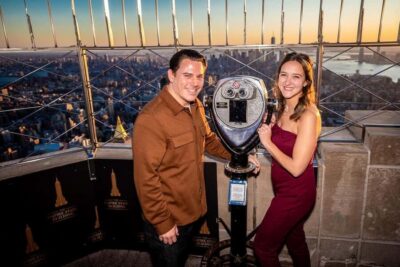
★ 4.7 · 51,195 reviews - NYC: Empire State Building Tickets – Observatory & Museum
★ 4.7 · 25,757 reviews - New York City: Statue of Liberty & Ellis Island with Ferry
★ 4.6 · 18,683 reviews
Starting at Tweed Courthouse and City Hall
Your meeting point is in front of Tweed Courthouse at 52 Chambers Street. The courthouse was completed in 1881, and its ornate exterior gives the tour an immediate lesson in 19th-century New York. It is also tied to the era’s political corruption, so the opening is not just about decorative stonework.
The guide uses this area to introduce Brooklyn and New York’s civic story. That is a smart beginning because it places the bridge in a wider setting. The Brooklyn Bridge was not built as a pretty backdrop for photographs. It connected major parts of a growing city and changed the way people, goods, and ideas moved between Manhattan and Brooklyn.
You then pass City Hall and the Municipal Building. The Municipal Building is one of New York’s largest government structures and is known for its large public statue. These stops are exterior visits, not interior tours, so you should not expect to enter either building.
The first portion includes several short periods of explanation and standing. Guides such as Sean, Kevin, Charles, and Marcos have been praised for mixing solid facts with humor and local observations. The exact guide depends on the departure, but the format gives the leader room to answer questions and add stories.
Crossing the 1.1-mile Brooklyn Bridge
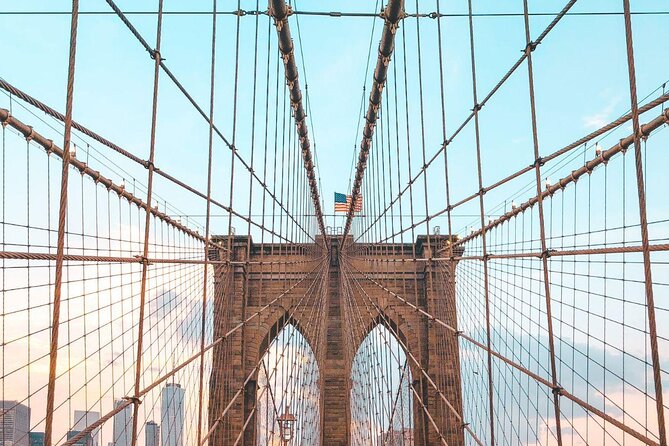
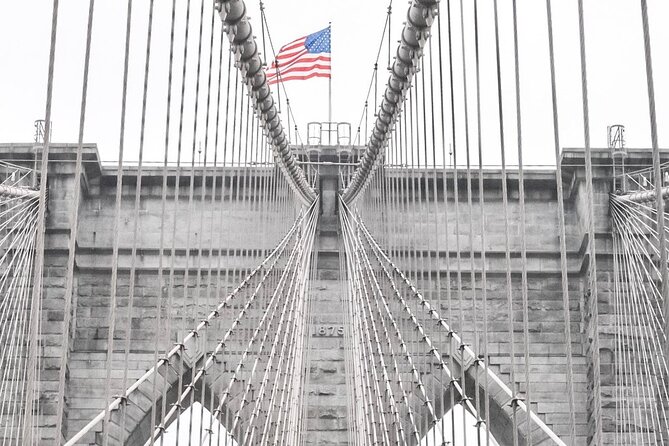
The bridge crossing is the heart of the experience. Built in 1883, it was once the longest suspension bridge in the world and was the first steel-wire suspension bridge ever constructed. Its design combines suspension and cable-stayed elements, which helps explain why the structure feels both delicate and powerful.
You walk about 1.1 miles, or 1.8 kilometers, across the bridge. The crossing itself is not described as hard, but you need to be comfortable walking for several hours and standing during explanations. One useful point from the tour format is that there is a scheduled public restroom stop, although this can add time if you prefer a brisk walk.
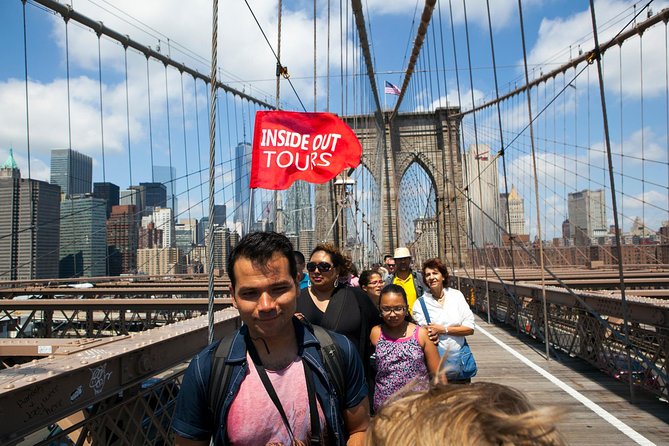
The bridge has a shared pedestrian and cycling path. Busy conditions are part of the deal. The guide may stop at several points so the group can catch up, hear another section of the story, and take photographs. That protects the slower members of the group, but it also means you may spend a few minutes waiting for everyone to gather.
This is where the group size matters most. With 25 or more people, it can be hard to hear if you drift too far from the guide. Stay near the front or middle of the group, and pay attention to the meeting instructions in case the group stretches out.
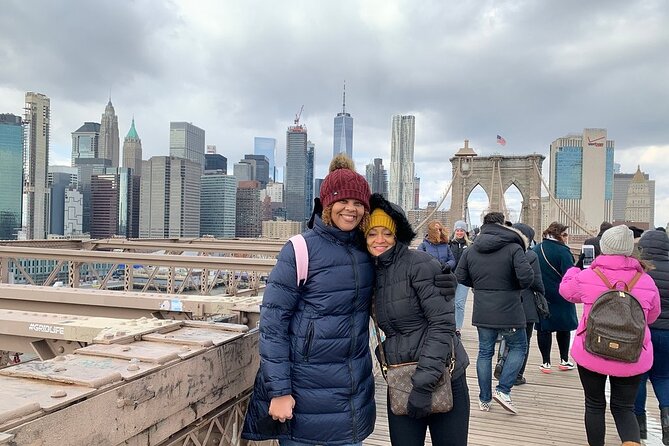
The views are the reward. Depending on where you look, you can see the Statue of Liberty, Ellis Island, the Empire State Building, the Chrysler Building, the Verrazzano-Narrows Bridge, and the Lower Manhattan skyline. The guide gives you reasons to pause, rather than sending you across with a quick list of landmarks.
Bring a phone or camera, but do not spend the whole crossing staring at a screen. The bridge’s stone towers, steel cables, and elevated walkway are as important as the skyline. A guide can point out construction challenges and explain why the bridge was such a daring project for its time.
Weather will shape the experience. The bridge is exposed, and one January participant found the walk freezing despite enjoying it. In cold or windy weather, wear a proper outer layer. In strong sun, bring water and sun protection. There is limited seating along the route, so do not count on regular places to sit.
Entering DUMBO under the Manhattan Bridge
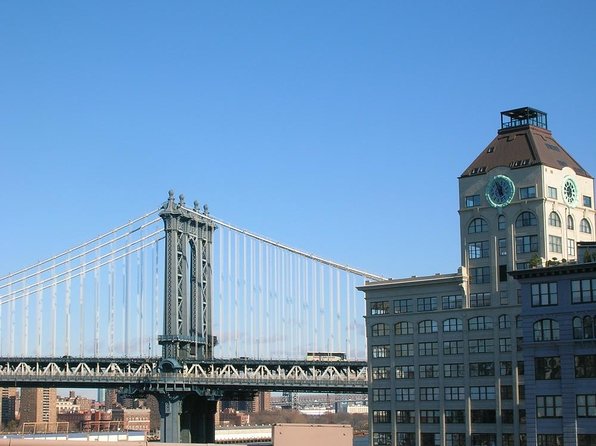
After crossing into Brooklyn, the tour turns toward DUMBO. The name refers to Down Under the Manhattan Bridge Overpass, and the neighborhood’s identity is closely tied to its position between the Brooklyn and Manhattan bridges.
DUMBO is a good contrast to the formal buildings at the start. You walk among cobbled streets and former warehouse buildings that now hold restaurants, cafes, shops, galleries, and performance spaces. The old industrial character has not vanished, but it now shares space with a polished arts and dining scene.
The tour includes about 30 minutes in DUMBO. That is enough for an introduction, not a full gallery crawl or food tour. The area includes places such as Klompching Gallery, St Ann’s Warehouse, and A.I.R. Gallery, though the tour description does not promise admission to any of them. Think of this segment as orientation.
This part is especially useful if you plan to remain in Brooklyn after the walk. Guides have offered lunch suggestions and local restaurant recommendations, and the location is well suited to continuing on foot. One of the practical strengths of the tour is that it does not leave you at the far end of the bridge with no plan.
Some people find the final DUMBO stops less necessary than the bridge and civic history. If your main goal is a fast bridge crossing, the neighborhood portion may feel slow. If you want to understand how a former industrial area became a major arts and dining district, the extra time is worthwhile.
A different kind of day, same corner of the map:
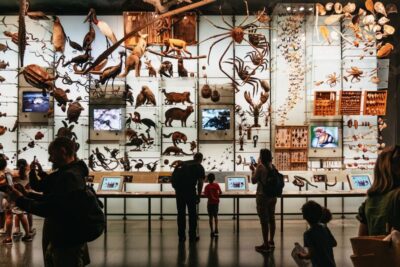
- New York City: American Museum of Natural History Ticket
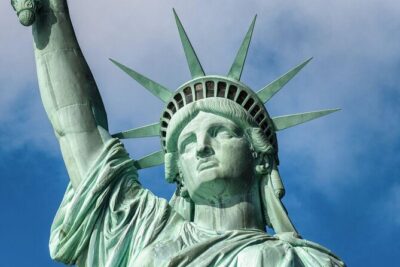
★ 4.5 · 15,447 reviews - Statue of Liberty and Ellis Island Tour: All Options
★ 5.0 · 13,571 reviews - New York in One Day Guided Sightseeing Tour
★ 5.0 · 13,166 reviews - NYC: Museum of Modern Art (MoMA) Entry Ticket
★ 4.6 · 12,540 reviews
Finishing at Brooklyn Bridge Park
The tour ends at Brooklyn Bridge Park, a large waterfront park covering about 85 acres. Its lawns, landscaping, family activities, and views make it a natural finish to the route.
This is one of the best places to look back at Manhattan after crossing from the city. The skyline feels different from Brooklyn than it does from the bridge, and the open park gives you room to pause after the guided walk.
The endpoint is listed as 2 Furman Street in Brooklyn. Since the tour ends here, you can choose your next step instead of returning to Manhattan with the group. You might continue exploring DUMBO, find lunch, enjoy the waterfront, or follow the guide’s directions to another part of Brooklyn.
The park also makes the tour a practical half-day plan. The scheduled walking time is about two and a half hours, but you should allow extra time if the group moves slowly or stops for questions. Afterward, DUMBO’s restaurants and cafes are close at hand.
Guides, group size, and the pace
The strongest part of this experience is the guide-led storytelling. Sean has been praised for his background in history and his connection to Brooklyn. Kevin is known for handling unexpected questions and offering a distinctly New York style of delivery. Tom has been appreciated for giving clear meeting instructions, planning a restroom stop, and offering onward recommendations.
Other named guides include Rori, Liam, Ludie, Charles, Marcos, Russell, and Shawn. The feedback on these guides points to a consistent pattern: strong bridge facts, local details, humor, and enthusiasm. You should not book expecting one particular person unless the operator confirms that guide for your date.
The pace is generally steady, with stops for photos, questions, and explanations. Several people have found it just right, including on chilly days. Others have found the repeated gathering points slow, especially when the group was near its 30-person limit.
I would treat the pace as part of the trade-off. A guide cannot safely leave people behind on a busy bridge, and a mixed-age group will not move at one speed. If you want a fast, uninterrupted walk, go independently. If you want the group kept together and the bridge explained in detail, the pauses are useful.
Wear comfortable shoes. The route includes city sidewalks, the bridge walkway, cobbled streets in DUMBO, and time on your feet. The operator describes the physical requirement as moderate. Anyone with walking concerns should check the route carefully before booking, since seating is limited.
Is $49 a good value?
At $49, this is not the cheapest way to see the Brooklyn Bridge. The bridge itself has no admission charge, and a self-guided crossing costs nothing beyond your time. You can also read about the bridge beforehand and follow a map.
The tour earns its price through structure and interpretation. You get a local guide, an introduction to Brooklyn and its civic history, bridge construction facts, the problems faced during construction, a planned crossing, and an organized look at DUMBO. For a first visit to New York, that package can save you from treating the bridge as a photo stop without understanding what you are seeing.
The value is also practical. You start near public transportation, finish in a place with food and further sightseeing, and receive suggestions for what to do next. A good guide can also answer the small questions that maps do not cover, such as where to eat in DUMBO or how to continue from the park.
The value drops if you already know Lower Manhattan and Brooklyn well, or if you dislike group walks. New Yorkers can still learn something from the bridge’s engineering and civic story, but independent walkers may prefer to set their own pace.
Who should book this walk?
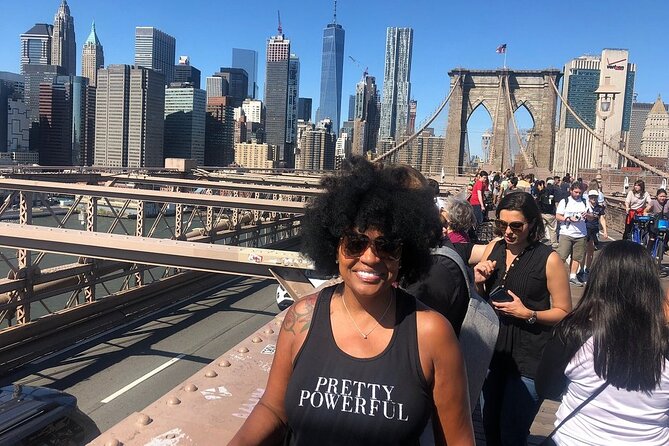
This tour suits first-time visitors who want a clear introduction to both sides of the East River. It also works well for families, couples, solo visitors, and friends who want a shared activity with a strong visual payoff.
History fans should enjoy the bridge construction material and the civic stops. Food-focused visitors will appreciate ending near DUMBO restaurants and cafes. Photographers get skyline views throughout the route, although the group schedule means you will not control every pause.
I would be cautious about booking if you have trouble walking or standing for long periods. Service animals are allowed, and the meeting point is near public transportation, but the provided details do not promise special seating, step-free access throughout, or a shorter route.
The tour is offered in English, and confirmation arrives when you book. Free cancellation is available if you cancel at least 24 hours before the local start time. Cancellations or changes inside that window are not refunded or accepted, and the tour requires a minimum number of participants to operate.
Should you book the Brooklyn Bridge and DUMBO tour?
Book it if you want the Brooklyn Bridge to make sense, not just look good in a photograph. The route combines Lower Manhattan’s civic landmarks, the bridge’s remarkable construction story, DUMBO’s converted warehouses and arts scene, and the wide skyline views from Brooklyn Bridge Park.
Skip it if your priority is speed, solitude, or complete control over the route. A group of up to 30 can create waits, and the restroom stop may feel long to some people.
For most visitors, I think the $49 is justified by the guide, the route planning, and the strong ending in DUMBO. Choose comfortable shoes, check the weather, stay close to the guide, and leave time for lunch after the tour.
FAQ
Where does the Brooklyn Bridge and DUMBO tour start?
The tour starts in front of Tweed Courthouse at 52 Chambers Street, New York, near City Hall.
Where does the tour end?
It ends at Brooklyn Bridge Park at 2 Furman Street in Brooklyn.
What time does the tour start?
The listed start time is 11:00 am.
How long does the tour last?
The tour lasts approximately 2 hours and 30 minutes.
How far do you walk across the Brooklyn Bridge?
The bridge crossing is about 1.1 miles, or 1.8 kilometers.
Is admission to the Brooklyn Bridge included?
Yes. Walking across the bridge is included, and no separate admission ticket is required.
What language is the tour offered in?
The tour is offered in English.
How many people can join the tour?
The maximum group size is 30 people.
Is the tour suitable for people with limited mobility?
The tour requires a moderate level of physical fitness. Anyone with walking concerns should check the route before booking because it includes the bridge crossing and periods of standing.
Can I cancel for a full refund?
Yes. You can receive a full refund if you cancel at least 24 hours before the experience start time. Cancellations within 24 hours are not refunded, and changes within that period are not accepted.
Newly listed in New York City
- Official Private NYC Central Park Horse Carriage Ride Since 1970™★ 4.5 · 447 reviews
- NYC at Night: 3-Hour Luxury Bus Tour of Top Highlights★ 4.5 · 448 reviews
- From Manhattan: 5-Hour Bronx, Queens, and Brooklyn Bus Tour★ 4.7 · 451 reviews
- Private Guided New York City Tour by SUV★ 5.0 · 451 reviews
- Statue of Liberty Tour with Ellis Island and Immigration Museum★ 4.0 · 452 reviews
- NYC: Official Grand Central Terminal Tour★ 5.0 · 458 reviews
- Circle Line: NYC BEAST Speedboat Ride★ 4.5 · 458 reviews
- New York City: Sunset Yacht Cruise★ 4.9 · 461 reviews
New York City Tours, compared.
Empire State Building Tickets – Observatory & Museum
Read our review →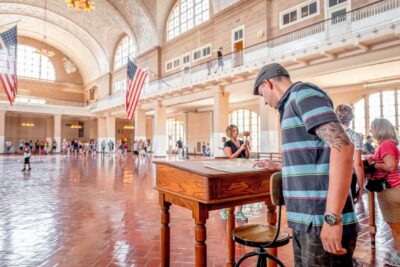
Statue of Liberty and Ellis Island Tour: All Options
Read our review →

New York CityPASS®: Save up to 41% at 5 Top Attractions
Read our review →Browse the lists this tour appears in