
Reviewed · BOSTON TOURS
The Full Revolutionary Story Epic Small Group Boston Walking Tour
Boston’s revolutionary story makes far more sense when you follow it in chronological order, rather than simply marching from one Freedom Trail marker to the next. This three-hour-plus walk links Puritan Boston, the Sons of Liberty, the Boston Massacre, the Tea Party, Paul Revere, and the opening battles into one clear narrative.
I like two things here. First, the guides bring maps, character cards, Lego soldiers, and other visual aids, which help make crowded political events easier to grasp. Second, the route leaves the standard brick path often enough to show modern Boston, quiet burial grounds, public gardens, the North End, and the harbor. The tradeoff is simple: you walk a lot, often outdoors for 3 to 3.5 hours, so this is not the best choice if your legs, feet, or patience for weather are limited.
Key things to know before you book
- The story comes before the route: You visit landmarks in the order events unfolded, not just in geographic sequence.
- Small groups keep the lesson personal: The maximum is 15 people, with guides such as Tyler, Mike, Chris, and Tom leading animated, interactive talks.
- You see more than the Freedom Trail: The route adds Post Office Square, the Financial District, the Greenway, North Square, the waterfront, and modern city life.
- Expect a serious walk: The experience lasts about three to three and a half hours and calls for moderate physical fitness.
- The North End is your reward: You finish near Lewis Wharf, close to Italian food, pizza, seafood, cannoli, public transport, and Boston Harbor.
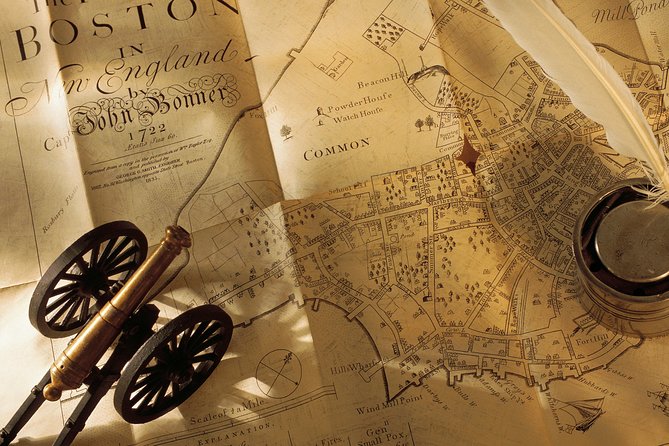
- The teaching style is active: Maps, props, character badges, and small visual demonstrations turn the tour into a moving history class.
Why the chronological route works in Boston
Boston’s Freedom Trail is easy to follow but not always easy to understand. Its red brick line connects major sites across downtown, yet the trail’s geographic order does not match the order of the American Revolution. You can see a church, a meeting hall, a burial ground, and a government building without understanding how one led to the next.
This walk tackles that problem head-on. You begin with the people and beliefs that shaped early Massachusetts Bay, then move through the growing conflict between local political rights and British authority. By the time you reach the Boston Massacre and Old South Meeting House, the setting has a clear role in the story.
I especially like this approach for anyone who knows the famous names but not the sequence. Paul Revere, John Hancock, Samuel Adams, Benjamin Franklin, and the Sons of Liberty stop feeling like disconnected figures. The guide explains who they were, what they wanted, and how their choices fit into the pressure building around Boston.
The teaching is not presented as a costume show or a staged battle. The company describes its guides as scholars, and the experience aims to explain rather than reenact. That makes it a good fit for adults, history students, and families with older children who want more than a string of quick facts.
More Walking Tours in Boston
- Boston: Freedom Trail History Small Group Walking Tour
★ 5.0 · 6,450 reviews - Harvard University Campus Guided Walking Tour
★ 4.5 · 3,632 reviews - Boston Freedom Trail Walking Tour with Costumed Guide
★ 4.5 · 2,531 reviews
Starting at City Hall Plaza with modern Boston in view
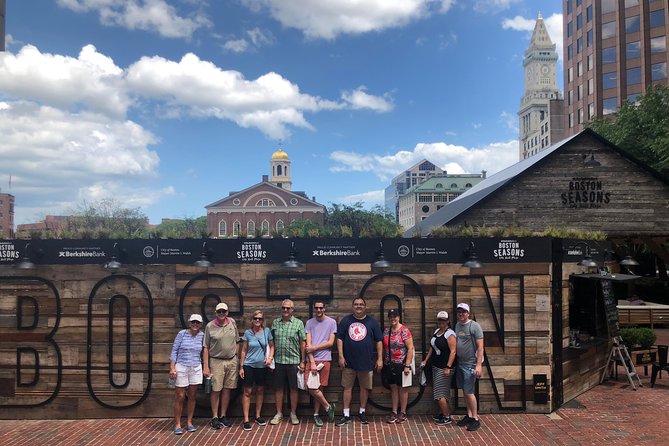
Meet at City Hall Plaza, between Five Iron Golf and Boston City Hall, near the seasonal beer garden and the large BOSTON sign. Faneuil Hall is behind you, making this a useful place for a first photograph and an easy downtown starting point.
The opening is more than a meetup. City Hall Plaza and Boston City Hall introduce the present-day city before the tour steps back into colonial Boston. The building’s unusual architecture also gives the guide an early chance to talk about how public spaces and civic buildings reflect arguments about democracy.
The plaza is pedestrian-only and directly across from Faneuil Hall. Still, make sure you allow enough time to locate the exact meeting spot. The large sign and Faneuil Hall backdrop help, but downtown Boston can feel busy and confusing when you are watching street names, maps, and restaurant signs.
A statue of basketball player Bill Russell near the BOSTON sign adds a distinctly modern Boston touch. It is a clever reminder that this is not a museum set. The city’s revolutionary past shares space with sports, offices, restaurants, transit, and everyday life.
King’s Chapel and the first Bostonians
King’s Chapel Burying Ground is the first major historical stop. Here, the guide talks about the people who settled Massachusetts Bay and the unusual religious and social world created by the Puritans.
This beginning matters because the Revolution did not appear from nowhere in 1775. The political culture of Massachusetts had been developing for generations. Ideas about faith, authority, community rules, and local control shaped the way later residents reacted to British policy.
You also pass Boston’s first Anglican church. That contrast between Puritan roots and Anglican presence helps explain why religion and government were never entirely separate subjects in colonial Boston. The stop is short, but the context gives the early part of the walk a stronger foundation.
The burial ground itself is an outdoor site, so you are listening while standing on the street or pavement. If the day is wet or cold, you will feel it early. Wear layers and shoes with firm soles.
Granary Burying Ground and the people behind the slogans
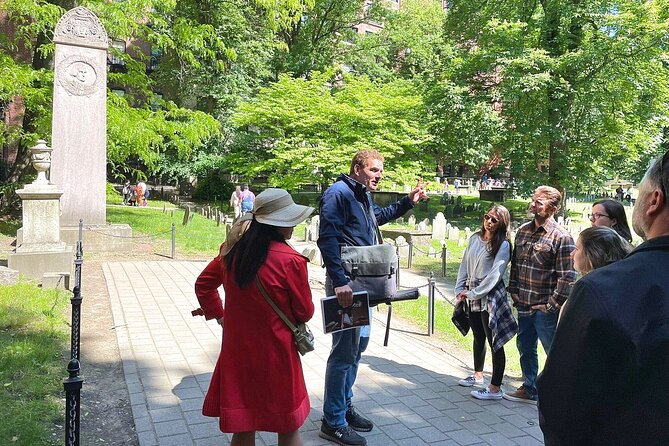
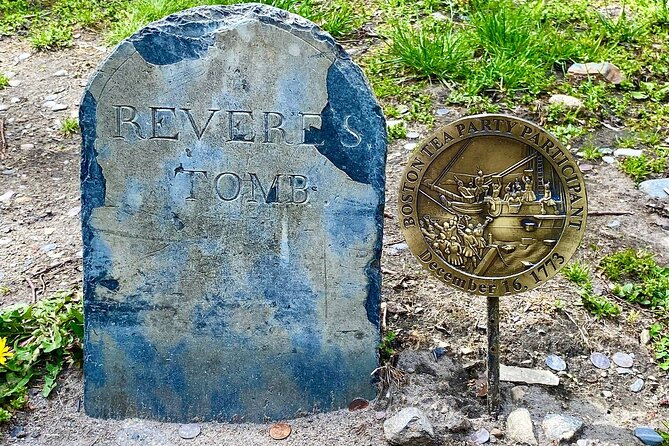
Granary Burying Ground brings you to the graves of Paul Revere, John Hancock, and Samuel Adams. It is one of the most familiar stops in Boston, but the guide uses it to ask a better question: who really were the Sons of Liberty?
That question is useful because the popular version of the Revolution often reduces the movement to a handful of heroic names. The discussion here looks at people, alliances, persuasion, and the work required to turn anger into organized resistance.
You do not just get a list of graves. The surrounding streets and stones become a setting for political personalities and competing goals. The guide connects people buried here with the buildings you will visit later, helping the route feel like one unfolding story.
The stop lasts about 15 minutes. That is long enough for explanation, but not so long that the burial ground becomes a lecture in place. Expect frequent pauses, rather than a continuous walk.
More walking tours around Boston:
- Boston’s Freedom Trail: A Revolutionary Walking Tour
★ 4.9 · 1,748 reviews - Boston: Freedom Trail History Small Group Walking Tour
★ 4.9 · 1,590 reviews - Boston’s Freedom Trail: A Revolutionary Walking Tour
★ 5.0 · 1,343 reviews - Boston’s North End Food Tour: Italian Flavors & Heritage Walk
★ 5.0 · 1,322 reviews
Old City Hall, Benjamin Franklin, and the argument over democracy
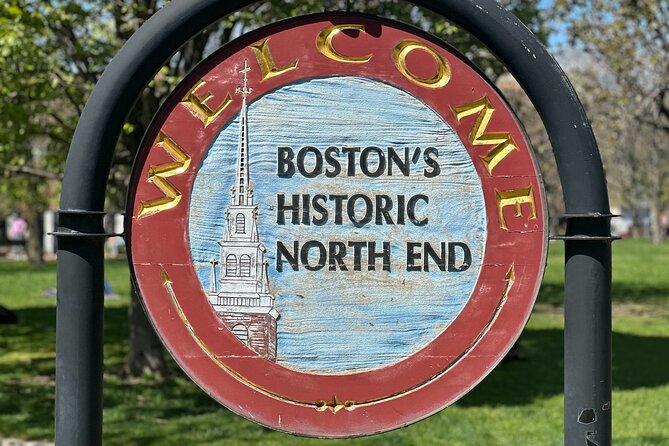
At Old City Hall, the architecture frames a talk about the obstacles and challenges built into democratic government. This is one of the tour’s useful departures from a basic Freedom Trail checklist. Instead of treating each building as a photo stop, the guide uses it to explore how power worked and who had access to it.
The Benjamin Franklin statue follows. Nearby, you learn about America’s first public school and Franklin’s connection to it. Franklin’s story broadens the tour beyond battles and protests. Education, printing, public debate, and self-improvement all mattered to the political world that produced the Revolution.
The presentation often includes character cards and visual material. That can be especially helpful when several people share similar names or when the story shifts quickly between colonial officials, merchants, printers, soldiers, and protest leaders.
The Old State House and the Boston Massacre

The Old State House was the center of Massachusetts politics and is described as the oldest public building in the country. Here, the guide places British authority and American claims of rights in the same physical setting.
That tension becomes more immediate at the Boston Massacre site. You hear about soldiers, citizens, loyalists, and patriot leaders caught in an explosive moment. The value of this stop is not simply knowing where the shooting occurred. It is understanding how different groups interpreted the same event and how the incident was used in the political struggle.
This is where a strong guide makes a real difference. The best version of the story does not treat one side as a cardboard villain and the other as perfectly united. The tour’s format leaves room for competing motives and the messy pressure of public opinion.
You also pass a former publishing house connected with American literary figures including Ralph Waldo Emerson, Henry Wadsworth Longfellow, and Nathaniel Hawthorne. It is a brief detour from the Revolution, but it shows how Boston continued to shape national culture long after independence.
Old South Meeting House and the road to the Tea Party
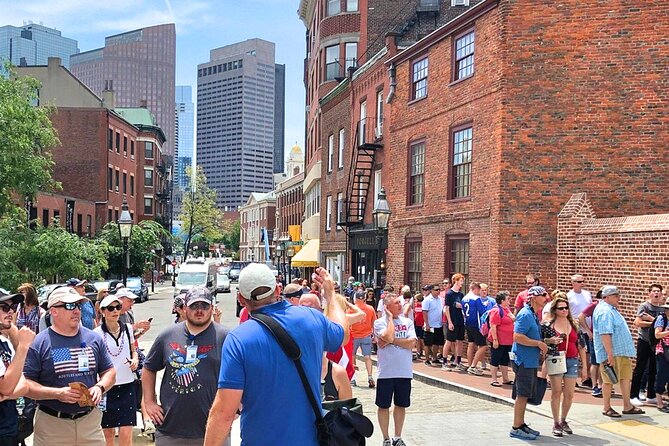
At Old South Meeting House, the story reaches its best-known breaking point. This is where the Boston Tea Party began, and the guide explains why a gathering that started as protest moved toward open rebellion.
The building gives the event a human scale. You can imagine a crowded meeting where choices had to be made in public, under pressure, with British power watching closely. The point is not simply that tea was dumped into the harbor. It is how debates, taxes, enforcement, and public action pushed Boston toward a point of no return.
The stop lasts about 15 minutes. If you want to enter the meeting house itself, museum admission is not included, so plan on paying separately. The tour does include a built-in break and access around Faneuil Hall and Quincy Market, but other museum entries are outside the tour price.
Post Office Square and Boston’s working present
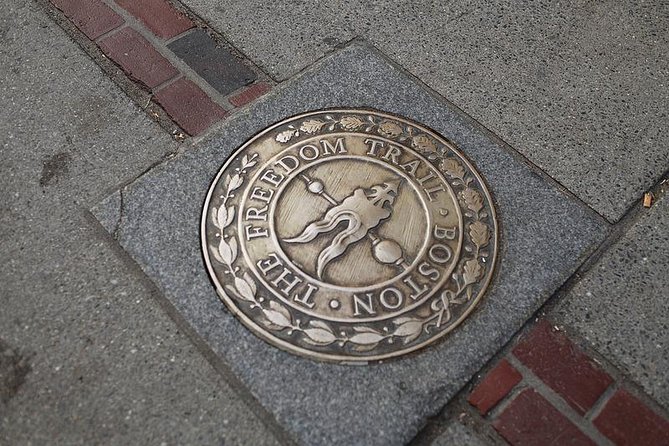
Post Office Square and the Financial District provide one of the walk’s best modern contrasts. Offices, finance, education, and health care now shape this part of downtown, while the route keeps you aware of the political conflict that once ran through these streets.
This section is valuable because it stops Boston from becoming a frozen colonial postcard. The city has grown around its old foundations. You get a lesson in the Revolution, but also a brief reading of how today’s business center fits into the older city.
I like this kind of pause because it lets you reset before the next cluster of major sights. The drawback is that the modern blocks can feel less picturesque than the burial grounds and narrow North End lanes. The payoff is context, not charm.
Faneuil Hall and Quincy Market
Faneuil Hall is known as the Cradle of Liberty, and the guide explains how its political role helped turn protest into organized resistance. This is one of the places where the physical building and the story line up neatly.
The nearby Quincy Market is more commercial and more tourist-oriented. You will have time to see it, and the guide is candid about the tourist-trap side of the area. That honesty is useful. You can enjoy the market, but you should not mistake every food stall or souvenir shop for an authentic local experience.
The area is also practical. It sits near the start of the walk and offers food, restrooms, and a chance to get your bearings. Since the tour continues toward the North End, do not spend all your energy here if you are already feeling the distance.
Rose Kennedy Greenway and the route beyond the brick line
The Rose Fitzgerald Kennedy Greenway is a public garden running through downtown Boston. It gives you open space after the denser streets and provides a clear example of the city’s modern public life.
This is one of the places that separates the experience from a strict Freedom Trail march. You are not only following colonial landmarks. You are seeing how Boston has reshaped its center and created places for people to walk, rest, and meet.
From here, the route works toward the North End. The change is noticeable. Streets become more intimate, the history feels closer to daily life, and food becomes part of the tour’s practical advice.
Paul Revere’s house and North Square
The Paul Revere House sits in North Square, one of Boston’s oldest and most appealing residential settings. The guide explains why Revere was more than the legend of a midnight ride. His trade, connections, and place in Boston society help round out the familiar image.
The house is not included as an interior museum visit, so you should not expect a full tour inside. Instead, the surrounding square and the guide’s account give you a strong sense of the neighborhood where Revere lived.
North Square is also a fine place to pause for photographs. It is surrounded by restaurants, and the North End is a natural place to return after the walk for Italian food, seafood, pizza, or cannoli.
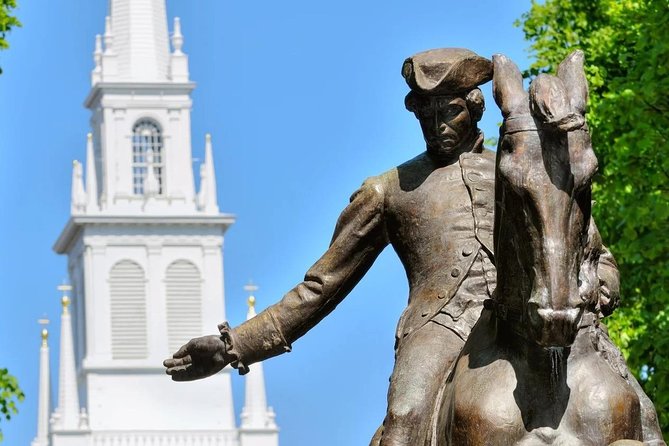
A statue of Paul Revere offers another classic photograph. The stop is brief, but it is well placed in the sequence, after the political buildup and before the account of the midnight ride.
Old North Church, Bunker Hill, and the harbor view
At Old North Church, the guide explains the famous signal of one lantern by land and two by sea, then follows Paul Revere’s ride toward Lexington and Concord. The story culminates in the first major fighting and the phrase shot heard round the world.
The route also covers the Battle of Bunker Hill, described here as the largest battle of the American Revolution. Visual aids, maps, and Lego soldiers can make this segment easier to follow than a spoken account alone. One of the tour’s guides has used Lego figures to show how the battle unfolded, a simple device that can make troop movement and terrain far clearer.
You do not receive admission to every historic site, and the itinerary treats some locations from outside. The second-oldest burial ground in Boston is viewed from the exterior, with a terrace across the street offering views toward Charlestown and Boston Harbor.
The USS Constitution, known as Old Ironsides, is also discussed from across the harbor. The guide explains its later naval story and offers advice on seeing it separately. It was not part of the American Revolution, so this is a useful historical boundary rather than an attempt to force every Boston attraction into the same chapter.
The North End and Boston Harbor finish
The North End is the oldest residential neighborhood in America, and the tour ends where history, food, and waterfront views meet. The guide talks about the neighborhood’s Italian culture, seafood, pizza, and cannoli, then leads you along Boston Harbor and the Harborwalk.
This final section is more than a finish line. The waterfront offers wide views of the city and a fresh-air break after hours among downtown buildings. The route uses piers, wharfs, and waterfront parks that many short Freedom Trail walks skip.
The endpoint is Lewis Wharf, in the heart of the North End. It is close to public restrooms, parking, bicycles, public transport, and the Aquarium T stop. It is also less than a ten-minute walk from the original meeting point, which makes returning to City Hall Plaza fairly simple.
Ask the guide for restaurant suggestions before you leave. The end of the walk is well timed for lunch or an early meal, and the North End gives you far better options than grabbing a rushed snack at Quincy Market.
Is $55 a fair price?
At $55 per person, this is not the cheapest way to see the Freedom Trail. You can walk much of the trail on your own for free, and many landmarks have outdoor viewing areas that cost nothing.
The value is in the structure and instruction. You get roughly three to three and a half hours with a guide, a small group capped at 15, a chronological explanation, visual aids, modern Boston context, and a route that covers far more than the brick path alone. For someone who wants to understand the Revolution rather than collect building photographs, that is a fair price.
You should also account for what is not included. Transportation is not provided, and museum entry beyond the included Faneuil Hall and Quincy Market access is extra. Gratuity is optional.
Who will enjoy this walk most?
I would choose this for:
- History fans who want causes, personalities, and political context.
- First-time Boston visitors who want a strong orientation to downtown and the North End.
- Families with older children who can handle a serious lesson and a long walk.
- Solo visitors who want company without joining a huge group.
- Anyone who likes active teaching, maps, props, and questions rather than a memorized speech.
I would think twice if you have mobility issues, dislike standing outdoors, or want a short, relaxed introduction. The route is described as suitable for moderate physical fitness, and the long duration is a real feature, not a minor footnote.
Children are welcome, but this is not a simplified kids’ show. Young people who enjoy stories, participation, and history can do well here. Very young children may find the length and detail demanding.
Practical advice for a better day
Wear comfortable walking shoes. The route covers a large part of central Boston, and one direct comment about the experience is worth taking seriously: you walk a lot.
Check the weather before you go and dress for exposure. The tour takes place outside, and cold, rain, and wind can affect your enjoyment even when the guide is energetic. Bring water and plan your meal for the end, when you reach the North End.
The group maximum of 15 is a useful middle ground. You get more personal attention than on a large coach-style walk, but the tour still has enough people for questions and group interaction. Guides named Tyler, Mike, Chris, and Tom have led recent departures, and their teaching styles include humor, maps, character cards, and physical demonstrations.
Free cancellation is available up to 24 hours before the start time. If poor weather cancels the tour, you are offered another date or a full refund. A minimum number of participants is required, and a cancellation for that reason also brings the choice of another date or a full refund.
Should you book The Full Revolutionary Story Epic Small Group Boston Walking Tour?
Book it if you want Boston’s Revolution explained as a connected story, not as 16 isolated stops. The chronological route, strong teaching style, North End finish, and mix of old and modern Boston make it especially useful early in your visit.
Skip it if you want indoor museum time, little walking, or a quick photo tour. At $55, you are paying for the guide’s interpretation and the extra context. For history-minded visitors who can manage the distance, that is the point of the experience, and it is where the tour earns its price.
FAQ
How long is the Boston Revolutionary Story walking tour?
The tour lasts approximately 3 to 3.5 hours.
How much does the tour cost?
The price is $55 per person.
Where does the tour begin?
It begins at City Hall Plaza, 1 City Hall Square, Boston, near the large BOSTON sign, Five Iron Golf, the seasonal beer garden, and Faneuil Hall.
Where does the tour end?
The tour ends at Lewis Wharf in Boston’s North End, close to Boston Harbor, public restrooms, parking, bicycles, public transportation, and the Aquarium T stop.
How many people can join the tour?
The group has a maximum of 15 participants.
What language is the tour offered in?
The tour is offered in English.
Does the price include museum admission?
Faneuil Hall and Quincy Market are included in the route, but museum entry beyond those sites is not included.
Is the tour suitable for children?
Children are welcome, but they must be accompanied by an adult. The tour is designed for all ages, but it is not a simplified children’s version of the history.
What happens if the weather is poor?
If poor weather causes the tour to be canceled, you are offered a different date or a full refund. You can also cancel for a full refund up to 24 hours before the experience begins.
Newly listed in Boston
- New England Aquarium Admission Ticket in Boston★ 4.0 · 446 reviews
- Boston’s Politically Incorrect North End Food Tour★ 5.0 · 453 reviews
- Boston’s North End Food and History Walking Tour★ 5.0 · 459 reviews
- Downtown Freedom Trail, Beacon Hill & Back Bay Walking Tour★ 4.5 · 473 reviews
- Cambridge, Massachusetts: MIT and Harvard Walking Tour★ 4.7 · 486 reviews
- Narrated Sunset Cruise of Boston Harbor★ 4.0 · 532 reviews
- Sightseeing Day Sail around Boston Harbor★ 5.0 · 541 reviews
- Boston: Harbor Sunset Yacht Cruise★ 4.6 · 570 reviews
Boston Tours, compared.
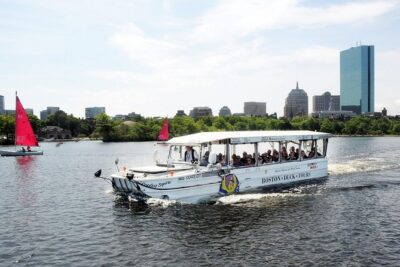
Boston Duck Boat Sightseeing City Tour with Cruise Along Charles River
Read our review →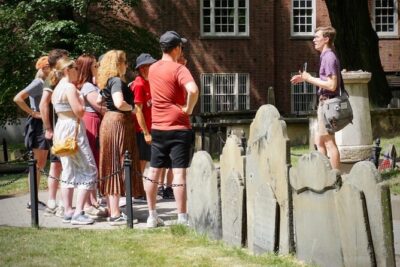
Freedom Trail History Small Group Walking Tour
Read our review →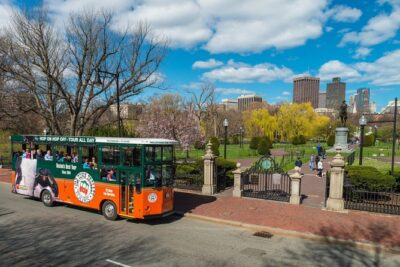
Boston Hop-On Hop-Off Trolley Tour with 13 Stops
Read our review →

Boston Duck Tour: The Original and World-Famous
Read our review →
Harvard University Campus Guided Walking Tour
Read our review →
Boston Fenway Park: Guided Ballpark Tour with Options
Read our review →
Boston to Martha’s Vineyard Day Trip with Optional Island Tour
Read our review →Browse the lists this tour appears in